Why one door stains darker than its neighbor
Stain goes wrong in a handful of familiar ways. Porous woods drink it unevenly, so a door can come out dark at the end grain and blotchy across the face while the board beside it looks calm. Doors cut from different boards take color differently, and a color that looked right on a small sample looks different once it covers a full raised panel under kitchen light.
The other trouble shows up days later. A finish put on too heavy, or into cold or damp air, can stay tacky under a skin that feels dry, and a tacky door collects fingerprints, dust and the sticky ghost of whatever it was stacked against. A door that never matches its neighbor is usually a door that was finished on a different day, in different air, with a different pass of the brush or gun.
That is why finishing is the step a homeowner sees first and forgives last. Cabinet construction can be perfect and a mismatched finish is still the thing people notice from across the room. Hardwoods with strong figure, like mahogany and sapele, reward careful finishing, because the stain deepens the ribbon of the grain and any streak or lap mark deepens with it. Paint hides the grain but not the mistakes, and a painted door shows every run, dry spot and rough edge once the light rakes across it.
Finished in the shop, dried on the rack
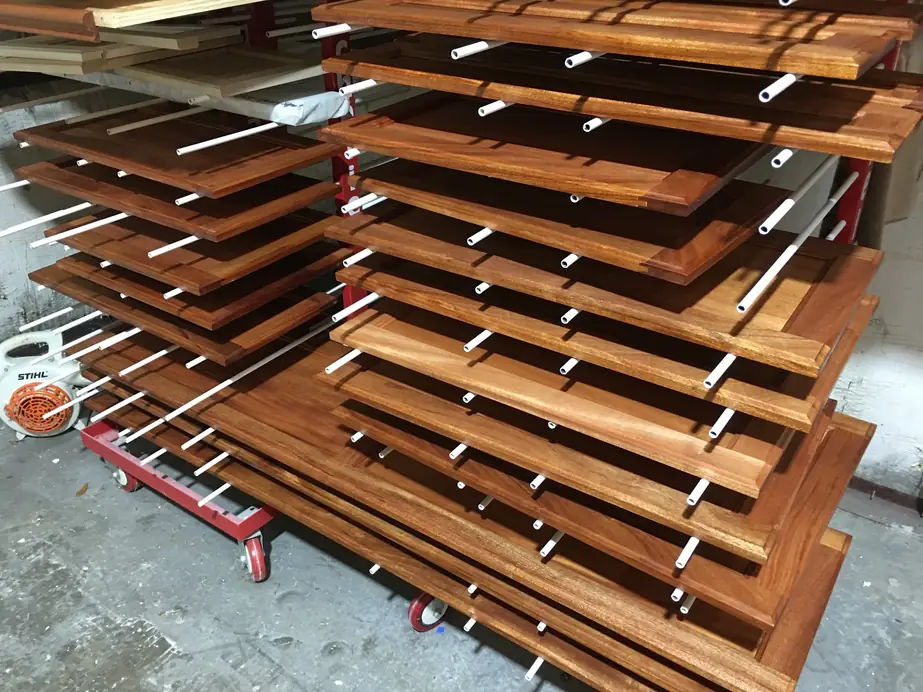
At Interior Wood Design the doors are finished in the shop on Carl Vinson Parkway in Warner Robins, not sent out and not left for someone else to match later. The picture on this page shows the rolling rack in that shop, loaded with freshly finished mahogany and sapele doors, the figured grain still carrying a wet sheen.
A rack matters more than it sounds. Doors that dry apart from one another, off the bench and out of the way, get air on both faces and are not touched while the finish sets. A rolling rack lets the doors for one kitchen be coated, wheeled aside and left together, so they sit through the same hours in the same air, which is how a full set of doors ends up reading as one color instead of a collection. It also keeps the shop floor honest: a door with a flaw is easy to spot on a rack, stood up and turned to the light, long before it is hung on a cabinet in somebody's kitchen.
If you have a door you like, bring it. A sample door from your current kitchen, a swatch or a photo is enough to start the conversation, and the showroom is the place to hold it next to real wood in real light. Call (478) 923-5400 and ask for a time to come in.
The first weeks with a fresh finish
A new finish keeps hardening for a while after it feels dry to the touch. In the first weeks, go gently: do not stack heavy items against door faces, keep rubber shelf liners and sticky mats off painted or freshly finished surfaces, and hold off on strong cleaners until the surface has had time to settle. A door that has been closed hard against a damp towel or a hot pan lid in week one can print that mark into the finish, so give a fresh kitchen a little patience before you put it through a full holiday of cooking.
For everyday cleaning, a soft cloth that is damp rather than wet does the job, followed by a dry one. Ammonia sprays and abrasive pads dull a finish quickly. Around the sink and the range, wipe splashes as they happen, because standing water and cooking grease are what mark a cabinet door first.
Small nicks and scuffs are a different matter. A hardware store marker rarely matches a finish that has depth, and a bad patch is harder to fix than a clean nick. If a door picks up a mark, call the shop at (478) 923-5400 and describe it before you reach for a touch-up pen.