Crown that opens at the corners, and a hood with nothing around it
Crown moulding is judged at its corners. A mitered joint cut at the textbook angle looks fine on the day it goes up, then opens into a thin dark line the first time a wall moves with the seasons. Houses in this part of Georgia swing between damp summers and dry winters, and wood follows that swing whether or not anyone planned for it. A joint that was not built to flex is the first thing to show it.
Walls are also never as square as the plan assumes. An inside corner that measures 91 degrees instead of 90 will not close on a standard miter, and a ceiling that wanders a quarter inch over a twelve-foot run will leave a gap under the top edge of the crown. Trim cut by number instead of fitted to the wall ends up caulked into place, which hides the problem for a season.
A range hood with no surround is the other common gap. A bare metal or drywall hood stuck between two cabinet runs looks like an appliance that wandered in, and it leaves a blank spot in what would otherwise be the most striking wall in the kitchen. A surround turns it into part of the cabinetry instead of an exception to it.
Corbels, crown and hood surrounds cut to sit with the cabinets
Good trim is fitted, not just cut. Inside corners are coped, which means one piece is profiled to nest over the face of the other, so a small shift in the wall opens a hairline in a spot nobody sees instead of a visible miter. The crown is scribed to the ceiling where it meets an uneven line, and the run is planned so the seams fall at corners and cabinet breaks rather than in the middle of a clear stretch of wall.
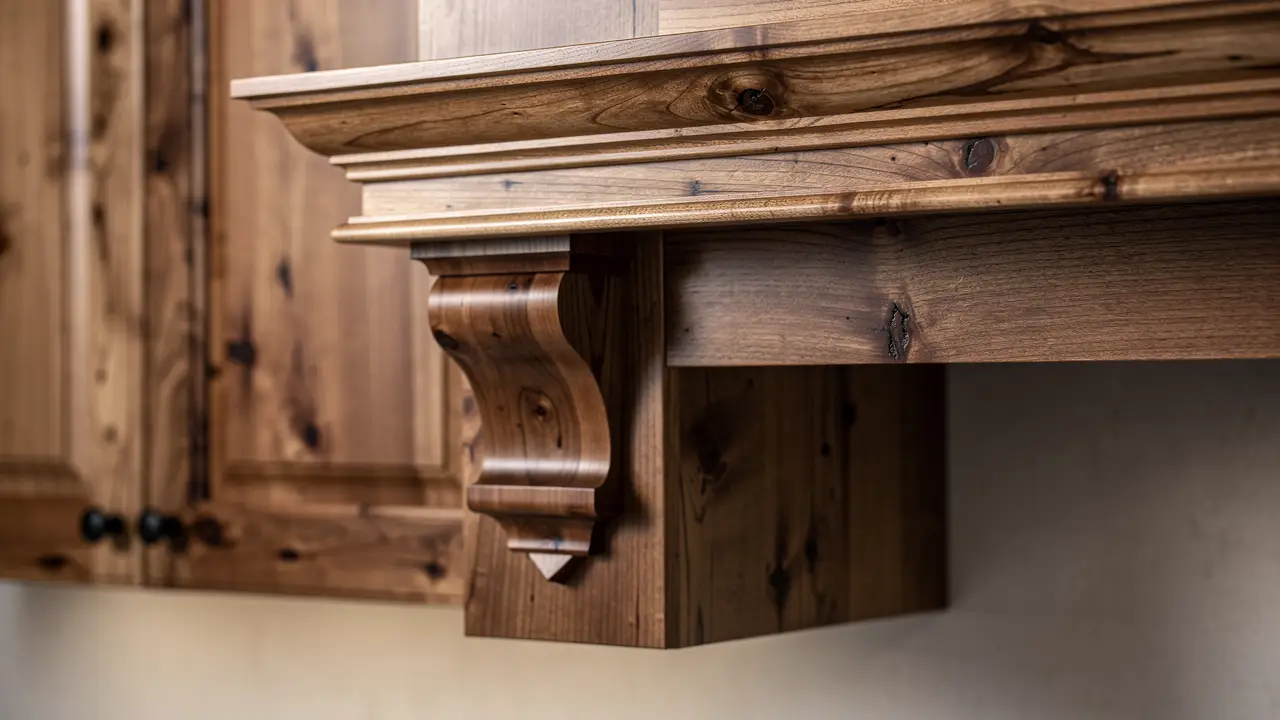
The display kitchen in the showroom at 323 Carl Vinson Parkway in Warner Robins shows how the pieces work together. Carved corbels carry the line of a custom hood surround, with crown above tying into the tops of the cabinets beside it. Because the surround is built alongside the cabinets rather than bought separately, its door-and-frame proportions repeat the cabinet faces around it.
Corbels do real visual work too. A carved corbel under a shelf or at the corner of a hood gives the eye a place to rest and gives a plain wall some depth. They are the kind of detail best judged by holding one in your hand and turning it in the light, which is easy to do in the showroom and hard to do from a photograph.
Matching trim to the doors, and when to re-caulk
Trim should be finished to match the cabinet doors, because the eye reads them as one piece. A stain that is slightly warmer than the doors makes the crown look like it came from another job. Doors here are finished in the shop and dried on racks, and trim that goes through the same finishing process takes the same color and sheen, which is a big part of why the whole wall looks like it belongs together.
Plan to look at the joints once a year. Painted trim and caulked seams will show tiny hairline cracks as the house moves through its seasons, and that is normal, not a defect. A thin bead of flexible, paintable caulk in an open seam and a dab of touch-up paint keep it tidy. Stained trim wants a matching filler, not white caulk, so the repair does not announce itself.
Reviewers describe Interior Wood Design as a great place to go for anything millwork related, and if you have a room in Warner Robins or elsewhere in Houston County that needs crown, corbels or a hood surround, call (478) 923-5400. Bring a photo of the wall and the ceiling height and we can talk through what will fit. The showroom is open Monday through Friday from 8:30 to 5:00, and Saturday by appointment.